Grain to Glass: Resurrecting Deschutes Twilight Summer Ale
Overview
Deschutes out of Bend, Oregon is a Pacific Northwest staple, and has been pretty much since they started all the way back in 1988. They make some of my favorite beers, including Mirror Pond Pale Ale, Black Butte Porter, and a couple of great seasonal beers: their late winter/early spring release Red Chair Northwest Pale Ale, and their winter warmer Jubelale, the packaging of which features new art from a local artist with each release.
Another of my favorite Deschutes seasonals that was usually released in May and was available through September or until they ran out, was Twilight Summer Ale.
Twilight Summer Ale was first brewed in 2004 and had a final run in 2015, after which Deschutes replaced it with their Hop Slice Session IPA as their summer seasonal. Twilight fans immediately revolted so after two years they brought it back briefly in 2018, but in the research I did it seems to have been discontinued again in 2020. I’ve also seen references to it being available in the taprooms more recently, and there are some sporadic reviews on the beer review websites including one review that listed a bottle fill date in 2021, so … who knows.
I haven’t seen it available near me in quite a while at any rate, so I figured it would be a fun project to try and resurrect one of my favorite summer seasonals.
Deschutes Style
If you see Deschutes Mirror Pond Pale Ale on the shelf next to Sierra Nevada Pale Ale, you might be tempted to think they’re more or less the same beer, which in a sense is understandable since they’re both West Coast American pale ales that have been around since the 1980s, and they both use exclusively Cascade hops.
You would, however, be wrong, because they’re actually quite different beers, and diving into the difference between Mirror Pond and Sierra Nevada Pale Ale serves as a great way to frame Deschutes overall style as a brewery.
We’ll get back to Twilight Summer Ale, I promise. Stick with me.
Sierra Nevada’s own homebrew recipe for their Pale Ale is two-row and caramel 60, and that’s it for the grains. This creates a crisp, neutral background against which the Cascade hops shine.
Mirror Pond, on the other hand, is a darker, maltier pale ale, almost leaning towards an amber, and while it also showcases Cascade hops at every stage from bittering through dry hopping, the grains are a much more prominent player in Mirror Pond than in Sierra Nevada Pale Ale.
Based on what I’ve read and the clone recipes I’ve seen, the grain bill for Mirror Pond is:
- Two-row. Specifically, from what I’ve read Deschutes sources their base grains from Great Western Malting out of Vancouver, WA.
- A light caramel malt. I’ve seen as light as caramel 10, and some clone recipes use a British crystal malt such as Carastan which is about 30-40 Lovibond and contributes more of a bright, honey-like sweetness compared to the caramel 60 in Sierra Nevada Pale Ale.
- Munich malt. This is the most distinct difference when compared to Sierra Nevada. Munich not only makes the beer a bit darker, it also contributes a fuller body and a malty, bready, toasty character that isn’t at all a component in Sierra Nevada.
The other big distinction is the yeast. Sierra Nevada of course uses the very clean, neutral Chico strain we all know and love.
Deschutes, on the other hand, uses their in-house English ale yeast. The most authoritative sources read about Deschutes stated they started with Ringwood yeast (available as Wyeast 1187), or some have said it’s more like the London ESB/Fuller’s strain (available as Wyeast 1968). Regardless of the specifics, the yeast most definitely is not a background player in Mirror Pond, and gives the beer a more complex, fruity, estery character when compared to the famously neutral Chico yeast.
Putting this all together gets to the heart of what I think of as the “Deschutes style.” It’s essentially an English-influenced West Coast American style, making for some really distinct and delicious beers.
Where Sierra Nevada Pale Ale is clean, crisp, and all about the punch of the Cascade hops, the English yeast and richer malt platform in Mirror Pond combined with Cascade hops make for a beer in which the hops, malts, and yeast are all contributing and working in harmony as opposed to any one ingredient being the star of the show.
Twilight Summer Ale
Told you we’d get back here!
This brings us to Twilight Summer Ale, which though a lighter beer with a different character than Mirror Pond, maintains the Deschutes foundation of English-American hybrid ale, incorporating Munich and Carastan alongside a two-row base and some dextrin malt.
Twilight also takes the complex interplay of malt, hops, and yeast even further with the inclusion of two American hops (Cascade and Amarillo), a German noble hop (Tettnang), and Northern Brewer, which has its origins in England as a cross between an English and American hop, was adopted extensively in the Hallertau region of Germany, and is a parent or grandparent of American hops like Nugget, Cluster, and CTZ so it ties the hop landscape together nicely.
And here again, there isn’t one thing that’s meant to be featured – it’s all about the interplay of all the ingredients, which makes for a complex, but still easy-drinking beer, with aromas ranging from grass to stone fruit to resinous hops to bready malts; flavors of bread, biscuit, honey, stone fruit, citrus, spice, and pine; and a soft hop bitterness in the finish.
Another interesting point about Twilight Summer Ale is that while it was an extremely well-regarded beer, winning Best Seasonal Pale Ale at the World Beer Awards in 2012, the actual style from a strict BJCP standpoint is a bit difficult to nail down. At the World Beer Awards, for example, the style was listed as an Oktoberfest/Maerzen, but it also won gold medals in the Bitter category at both GABF and the North American Beer Awards in the early 2000s.
My Interest in Twilight Summer Ale
In addition to this beer being a staple of my summers in the past and not being able to get it anymore, I also think this is a great vehicle for accomplishing one of my other goals as I move forward in my brewing journey, namely brewing the same beer multiple times and really dialing it in, something I don’t do nearly enough. This is not only a fantastic way to learn and improve my brewing, but the end result will be an interesting and rather unique summer beer that I can’t go out and buy.
Plus, I love the archaeology and nostalgia of the effort.
Building the Recipe
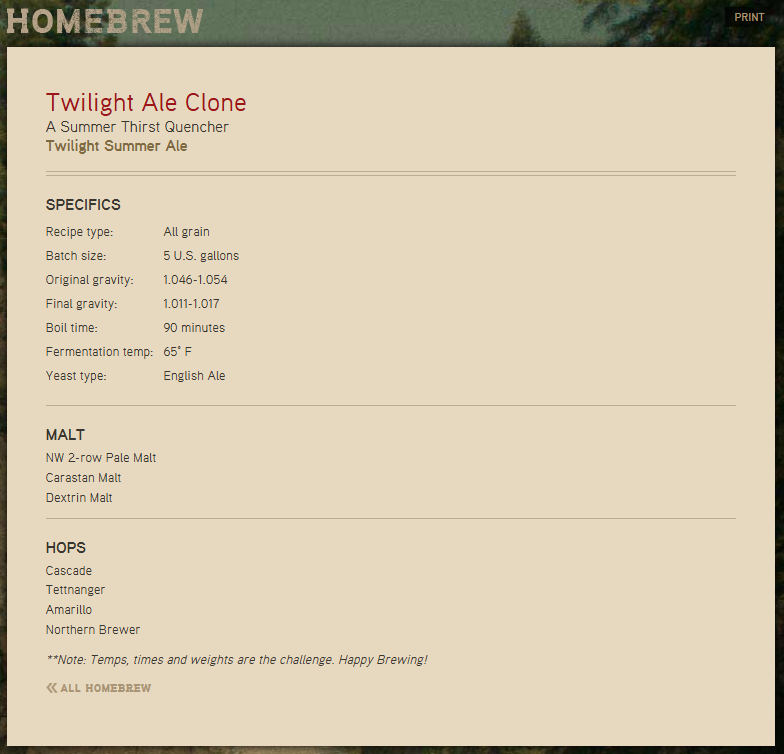
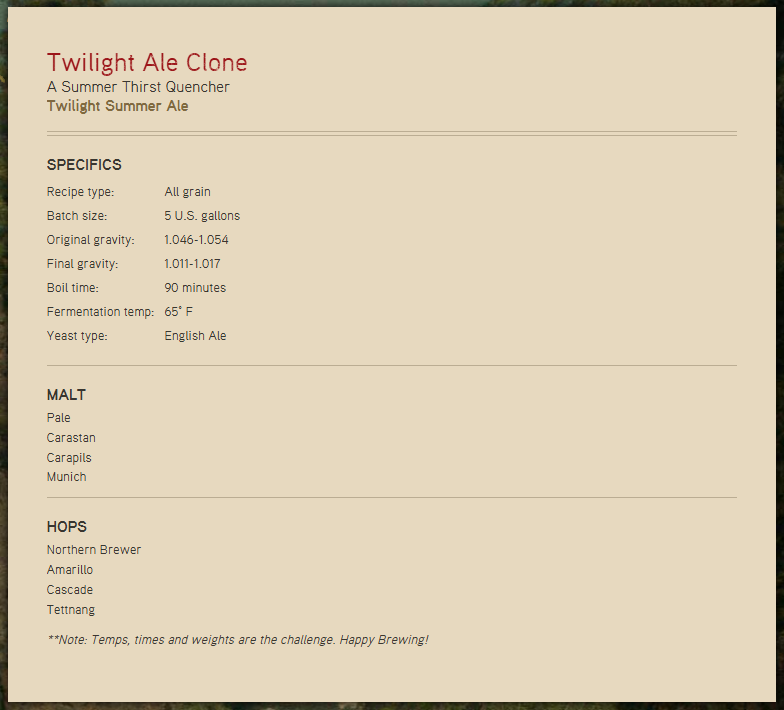
The subtle complexity of this beer and not having any on-hand to drink makes recreating it an interesting challenge, but Deschutes gave homebrewers some good guideposts on their website in the past, so that’s a great place to start.
2011 Homebrew Recipe from Deschutes Website
2015 Homebrew Recipe from Deschutes Website
My Interpretation
Given these clues from Deschutes as a starting point, and triangulating with some clone recipes I found online, here’s what I came up with for my first attempt.
Grains
- 81.9% Northwestern Pale Ale Malt (Great Western)
- 8.5% Light Munich (Avangard)
- 4.8% Carapils (Briess)
- 4.8% Carastan (Bairds)
I decided to use the Northwestern Pale Ale Malt from Great Western Malting specifically because it’s slightly more kilned than run-of-the-mill two-row, so it will contribute more bready and toasty notes and has a bit of honey sweetness, along the lines of, but less intense than, Maris Otter. There are also several other Deschutes-authorized clone recipes, including one for Red Chair Northwest Pale Ale, that specify “NW 2-row Pale Malt,” so I thought this would be a great base malt.
A quick note on Carastan since this was a new grain to me. As mentioned above, this is a British crystal malt that is stewed and roasted, and contributes caramel, toffee, and toasted bread flavors, as well as honey-like sweetness. Bairds recommends this be used for between 5-20% of the grist. In the case of this recipe I obviously didn’t want to go overboard with those flavors, particularly since Munich brings a lot of similar flavors to the party (minus the caramel/toffee), so I kept that on the low end of the range.
As for the other percentages, all I can say is that’s a mix of things I read and my gut sense of what might work well.
Hops
- Northern Brewer @ 60 mins (18.8 IBU)
- Cascade @ 30 mins (7.1 IBU)
- Tettnang @ 15 mins (3.6 IBU)
- Amarillo @ 5 mins (5.8 IBU)
- Amarillo @ dry hop (1.1 oz 8.5%AA) - 2 days at 60F
Given that the order of hops listed between the two available Deschutes recipes varied I figured that didn’t indicate the order of the additions, so here again I went with my gut of what I thought would work well in terms of the expression of the various hops.
Northern Brewer seemed to be the obvious choice for bittering since it’s a low-cohumulone hop and will give a smooth bitterness and contribute its characteristic earthy and woody base.
I went with Cascade half-way through the boil to get some of that classic Pacific Northwest grapefruit and pine bite without it being the primary hop characteristic, added Tettnang at 15 minutes to layer in floral, herbal, and spicy notes, and finished out with Amarillo late in the boil to get citrus and stone fruit in the mix.
I also dry-hopped with Amarillo after the batch hit final gravity at a cool 60 degrees Fahrenheit in the hopes of adding a citrus nose to the finished beer.
Yeast
I don’t tend to use liquid yeasts, and on my first attempt at this recipe I didn’t want the yeast to be too much of an unknown for me, so rather than go with a liquid strain that’s more directly in line with the Deschutes house strain, I went with Fermentis S-04.
I’ve always had fantastic luck with S-04. It ferments quickly, flocculates well, and particularly if you do a small temperature bump towards the end of fermentation, it has great, predictable attenuation. I figured this way I’d get the English ale yeast character contributions without introducing too many unknowns (to me) into the process.
Fermentation Schedule
- 65F until about 5 points from FG
- Raise to 70F for 2 days
- Drop to 60F for dry hop
- Cold crash at 34F for 3 days
I decided to ferment more on the cool side of S-04’s range to get some ester contributions without going overboard, but still getting reliable attenuation. Maybe a bit too reliable, as we’ll see later.
Water Chemistry
For the water profile I wanted to be sure and have the sulfate-to-chloride ratio to be high enough to get a good amount of hop bitterness so I went with a modified “Sweet Pale Ale” profile in Brewfather.
- Ca: 74 ppm
- Mg: 16 ppm
- Na: 5 ppm
- Cl: 65 ppm
- SO4: 150 ppm
- HCO3: 15 ppm
We’ll … come back to this later.
I also added a bit of lactic acid to get my pH to about 5.26.
The Brew Day
Not a lot to note here – I mashed at 152F for 60 minutes and followed the hop additions outlined above, and did a mash out at 168F.
One thing to note about hops related to the final result: I use a steam condenser lid, and I’m still a bit hit or miss with experiencing “hop explosions” where the boil with the steam condenser lid is too aggressive so the hops wind up on the side of the kettle, instead of doing their full job in the wort.
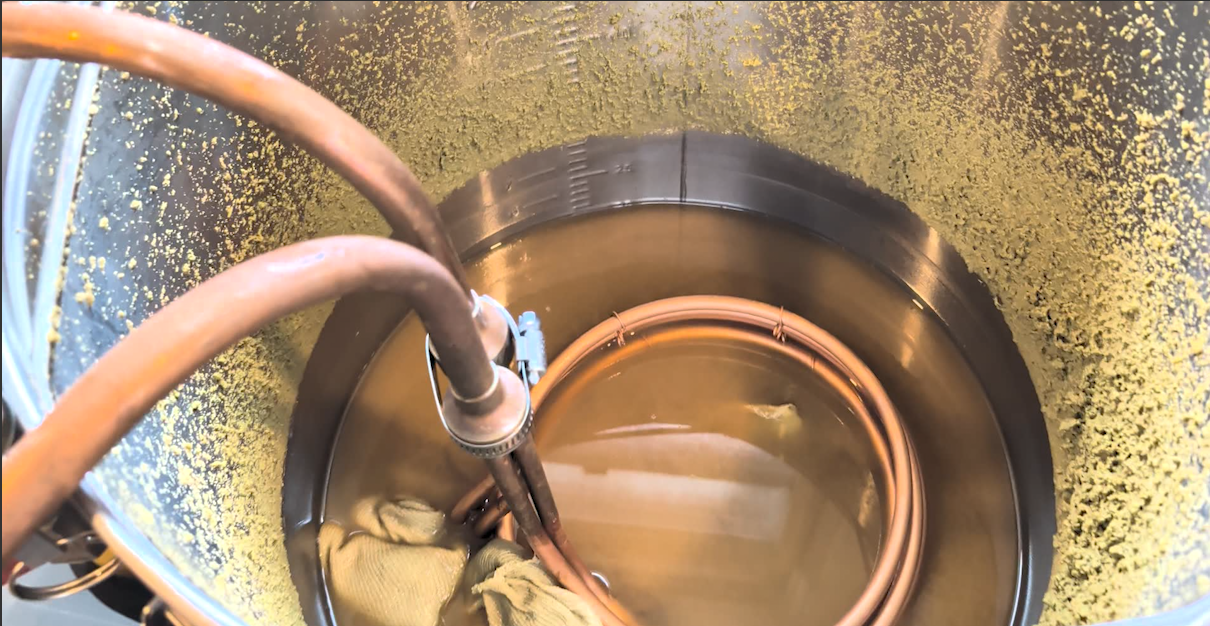
Obviously this isn’t great for hop utilization, so in the next batch I’ll drop the power from 55% down to 50% and see if that keeps the hop explosion from happening.
Fermentation
I don’t know why I have to remind myself of this every time I use it, but S-04 is a beast. At 65F it went from 1.051 OG to 1.011 in two days.
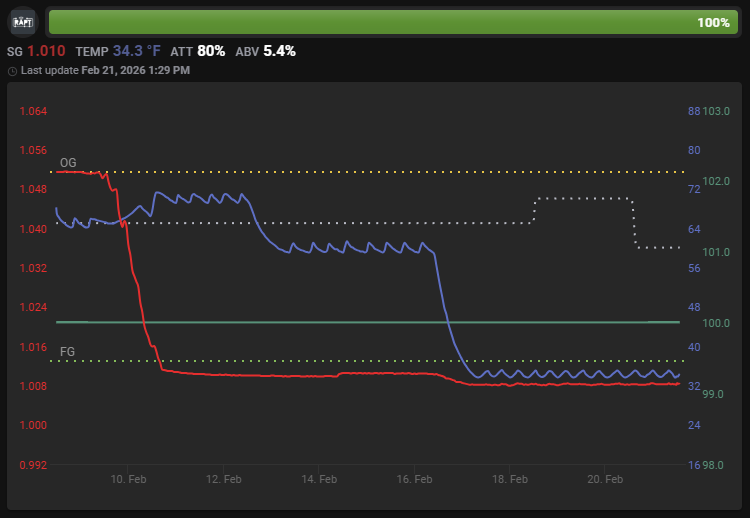
When the gravity hit 1.018 I raised the temp to 70F for a diacetyl rest, and then dropped the temp to 60F for a two-day dry hop before cold crashing.
We’ll also revisit the dry hop situation later.
The Final Product
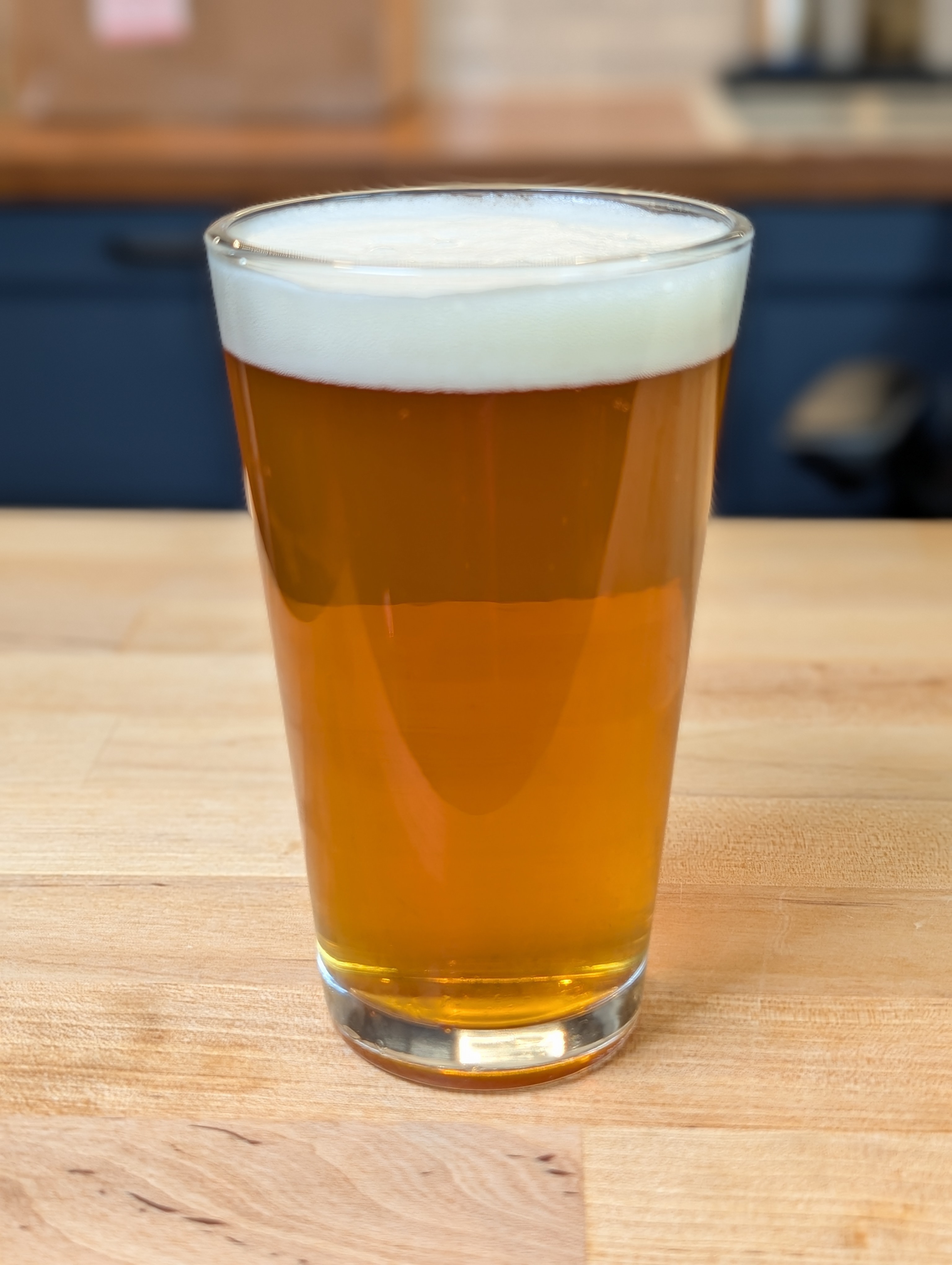
Here’s my “Afterglow Pale Ale.”
Appearance
I like the color – Brewfather estimates it coming in at an SRM of 8 – but it’s definitely not as clear as I’d like. I don’t tend to have issues with clarity between using whirlfloc at the end of the boil, cold crashing, and using Silafine in the keg, and given S-04’s reputation for high flocculation and that it’s been in the keg for about a month we’ll assume that isn’t the issue, so the primary suspects for the lack of clarity are:
- Hop oils from the dry hops
- Starch haze due to the crush being too fine (0.025”, but I use a brew bag)
- Cold crashing with the dry hops still in the fermenter
I’ll wait until the “what I’ll do next time” section before getting into solutions.
Aroma
The aroma is a bit lacking. There’s hints of hops and malt, but there isn’t the Amarillo hop punch of aroma I was shooting for. Definitely some work to do here.
Flavor
This isn’t a bad beer. But it isn’t a good beer either. I’d characterize the flavor as … discombobulated. The component parts are there, but they’re not working well together and aren’t cohesive. It’s not undrinkable by any means, but it’s not the harmonious result I was going for.
Troubleshooting and Fixes for Next Time
Luckily given the timing of me getting my act together to do a blog post and a video, in the interim I entered this beer into the 2026 Cascade Brewers Cup and got some excellent feedback.
The two judges who tasted my beer were a bit split, with one rating it a 33.5, and the other rating it a 36. So not bad scores, but clearly things I can work on, which I knew. (Honestly I’m harder on myself than the judges are so I was pleasantly surprised with the scores.)
Here’s the primary takeaways and areas of improvement from the lower-scoring judge:
- Hop aromatics are lower than desirable
- Some detracting estery aromas/flavors (banana, vanilla, “almost soap like”)
- Not hazy, but not brilliantly clear
- Hop flavor lacking, bitterness lower than appropriate for the style
- A touch astringent in the finish
- Thin mouthfeel
The higher-scoring judge liked the beer overall but picked up on a bit of oxidation (which surprised me given my process), and thought that this was what was pulling the malt “out above the hops” making things a bit out of balance.
The comment from the first judge that hit me most in terms of my own impression of this beer was this: “The beer has good bones but there are some issues with the hop versus malt profile.”
I won’t go through literally each of these in turn, but at a high level, here’s what I’ll address the next time I brew this.
Body, Malt/Hop Balance, and Overall Bitterness
In my tasting of it, this is the biggest area for improvement. As I drink this beer it’s like you can taste each component in turn as opposed to it being a cohesive experience.
I think the underlying cause of this lack of cohesion is a combination of the fact that it attenuated to a slightly lower final gravity than I was shooting for, making the body thinner than I wanted.
My impression is a fuller body will act as a kind of connective tissue to better integrate the various flavor components and, to borrow a phrase, “really tie the beer together.” I also need to address the “hop explosion” issue so I get the actual hop utilization I was targeting.
The Fix
Assuming similar efficiency and yeast performance in the next batch, the most obvious lever to pull here is mash temp.
Looking back at my 152F mash temp for what I was shooting for with this beer was a huge “what were you thinking?” moment, but live and learn. Next time I’ll bump that up to 155-156F to retain more unfermentable dextrins.
And as mentioned earlier, I’ll lower the power on the BrewZilla during the boil to keep the hops in the beer where they belong.
Estery / “Soap-Like” Aromas and Flavors
I gotta be honest here, I don’t get banana or vanilla out of this beer, but I’m also not nearly as experienced a taster as BJCP-certified judges.
That said, I have an idea of where this comment might be coming from, or at least the “soap-like” comment specifically.
Amarillo hops in particular are high in linalool and geraniol, which are terpene compounds that also show up in things like soap and cleaning products. The yeast can biotransform these during dry hopping into aromatic compounds that are more citrusy than perfumy and soapy.
In my case I dry hopped after FG had been reached, at a relatively cool temperature, and at a pretty high rate, at least for Amarillo. In addition, the dry hops stayed in the beer during the cold crash, for a total of six days (two days at 60F, 4 days at 34F).
So I’m speculating that given the temp, timing, and length of my dry hopping, the geraniol/linalool character leaned over into the perfumy/soapy side of things. That’s a guess on my part, but I can’t think of anything else in this recipe and process that would cause this sort of aroma and flavor.
The Fix
I’ll be honest: I have tended to roll my eyes when people start talking about biotransformation. But with Amarillo specifically, and given the results I’m tasting in this beer, I think it’s something worth trying.
So next time, given how quickly S-04 ferments, I think next time I’ll target dry hopping when the gravity hits 1.016-1.018 (close to the end of fermentation, but early enough that there’s still some yeast activity happening when the hops go in) to give biotransformation a try, and immediately ramp to 70F for the diacetyl rest, for a total of 2-3 days contact time. The increase in temperature will help with the geraniol-to-citronellol conversion better than the cooler dry hop I did for this batch, which is particularly important with Amarillo hops.
I’ll also use my FermZilla Tri-Conical next time so I can do a trub dump before the cold crash. That won’t get all the hops out of the mix, but it might help reduce the potential cause here of the Amarillo hops being in contact with the beer at a cool temperature for too long, and will also potentially help with clarity.
Clarity
Speaking of clarity, refer to the comments above for the prime suspects for the haziness in this beer, but I’m leaning toward #3 – leaving the dry hops in contact with the beer during the cold crash – as the biggest culprit.
The dynamic that comes into play in this situation is that the hop oils can coat yeast and protein particles and interfere with flocculation, as well as Silafine’s ability to bind to do its work of binding to proteins, polyphenols, and yeast to clarify the beer.
The Fix
Next time I’ll use the FermZilla Tri-Conical so I can dump the trub and at least some of the dry hops before doing the cold crash. I’m really interested to see what difference this makes.
Astringency in the Finish
To my palate, the astringency in the finish is the biggest flaw, and in my estimation this all points to water chemistry as the culprit.
I think my mistake here is that I thought, “Well this is an American Pale Ale, and given the caramel and bready notes from the malts, I want to have a sulfate-to-chloride ratio of 2:1 to really bring out the hops.”
A good guideline for a different type of pale ale or a West Coast IPA maybe, but not right for this beer.
Since the goal of this beer is to achieve a nice harmony between the malt and the hops, the sulfate-to-chloride ratio of 2:1 means the hops will cut through pretty sharply, and combined with the lower gravity and thinner body than I was shooting for, this means the amplified hop bitterness and the over-attenuation leads to an astringent, non-integrated character.
The Fix
Next time I’ll drop the sulfate-to-chloride ratio to closer to 1:1, and probably bump the chloride up to 75 ppm while cutting the SO4 down to 75 to have them meet in the middle to hopefully much better balance the hops and malt.
This, combined with the higher mash temp to retain more body in the beer, will hopefully lead to a much smoother outcome where the hops and malt work together instead of against one another.
Summary of Fixes for V2
To roll all this up, here’s what I’ll do differently next time. We’ll see how it pans out!
| Parameter | Original Batch (V1) | Proposed Fix (V2) | Rationale |
|---|---|---|---|
| Mash Temp | 152F | 155-156F | Retain more unfermentable dextrins for fuller body and better flavor integration |
| Boil Power | 55% | 50% | Prevent hop explosions and improve hop utilization |
| Suffate (SO4) | 150 ppm | 75 ppm | Reduce harsh, cutting bitterness and soften the finish |
| Chloride (Cl) | 65 ppm | 75 ppm | Shift SO4:Cl ratio from 2.3:1 to 1:1 to better support malt/hop harmony |
| Dry hop timing | At FG | At 1.016-1.018 (~5 points from FG) | Ensure active yeast present for biotransformation of Amarillo’s geraniol |
| Dry hop temp | 60F | 70F (with diacetyl rest) | Drive geraniol-to-citronellol conversion, reducing soapy/perfumy character |
| Dry hop contact | ~6 days including cold crash | 2-3 days at 70F only | Limit cold-side extraction of soapy hop compounds |
| Fermenter | FermZilla All-Rounder | FermZilla Tri-Conical | Enable trub/hop dump before cold crash for better clarity and cleaner cold crash |
Parting Thoughts
As a first attempt to re-create a beer that at this point I can only remember from summers past, even though it didn’t come out as well as I’d like I learned a lot in this batch. I’m glad I submitted it to the Cascade Brewers Cup to get some feedback from judges because this not only confirmed what I was tasting, but introduced some new information and framing of what I was tasting that helped tremendously in zeroing in on potential solutions for next time.
And there will be a next time for this beer. As I said earlier I don’t do a lot of re-brewing beers since there’s always another new style to brew or an experiment I want to conduct, but I think I found the perfect beer in this Twilight Summer Ale re-creation to not only learn a ton through dialing in a rather complex recipe that targets harmony between the malt and hops, but also hopefully achieve a delicious and unique house summer beer to have on tap.
Onward and upward! I’ll be sure and do a follow-up on the next attempt so we can see how the attempted fixes worked out.
Cheers!
Resources
- Deschutes Deconstructed, Brew Your Own Magazine, December 2016
- Homebrew Talk Thread on Twilight Summer Ale
- Porch Drinking Review of Twilight Summer Ale (2018)
- “The Return of Twilight Summer Ale,” The Bulletin, May 10, 2018
- Guys Drinking Beer Review
- World Beer Awards Best Seasonal Pale Ale 2012